

You took the SAT or ACT.
You opened the score report.
And your reaction was… meh.
Not bad. Not great. Just… okay.
You’re exhausted, the thought of test prep again makes your stomach drop, and now you’re stuck in one of the most common (and stressful) questions in college admissions:
Do I submit this score—or pretend it never happened?
If this is running through your head, take a breath. You are far from alone. Thousands of students every year sit in this exact gray zone.
Let’s talk through how to think about this strategically—not emotionally.
The Three Options Everyone Considers
Most students narrow their choices down to three paths:
-
Go test-optional
-
Submit the score and hope for the best
-
Bite the bullet, prep again, and retake the test
None of these are automatically right or wrong. The mistake is making the decision based on fear, comparison, or misinformation.
What Admissions Officers Are Actually Saying
Here’s something that surprises a lot of families:
Many admissions officers wish more students would submit their scores.
In conversations with multiple admissions teams, a consistent theme comes up:
Students are often far more self-critical than they need to be.
They assume:
-
“My score isn’t good enough for this school”
-
“Everyone else has way higher scores”
-
“Submitting will hurt me”
So they don’t submit.
What that does, admissions officers say, is leave room for interpretation—and not always in a good way.
The Most Underrated Tool: The Common Data Set
If you’re not using the Common Data Set (CDS), you’re making this decision blind.
Every college publishes one, and it quietly answers questions like:
-
What is the middle 50% SAT/ACT range?
-
What percentage of admitted students submitted scores?
-
How has this changed over the last few years?
-
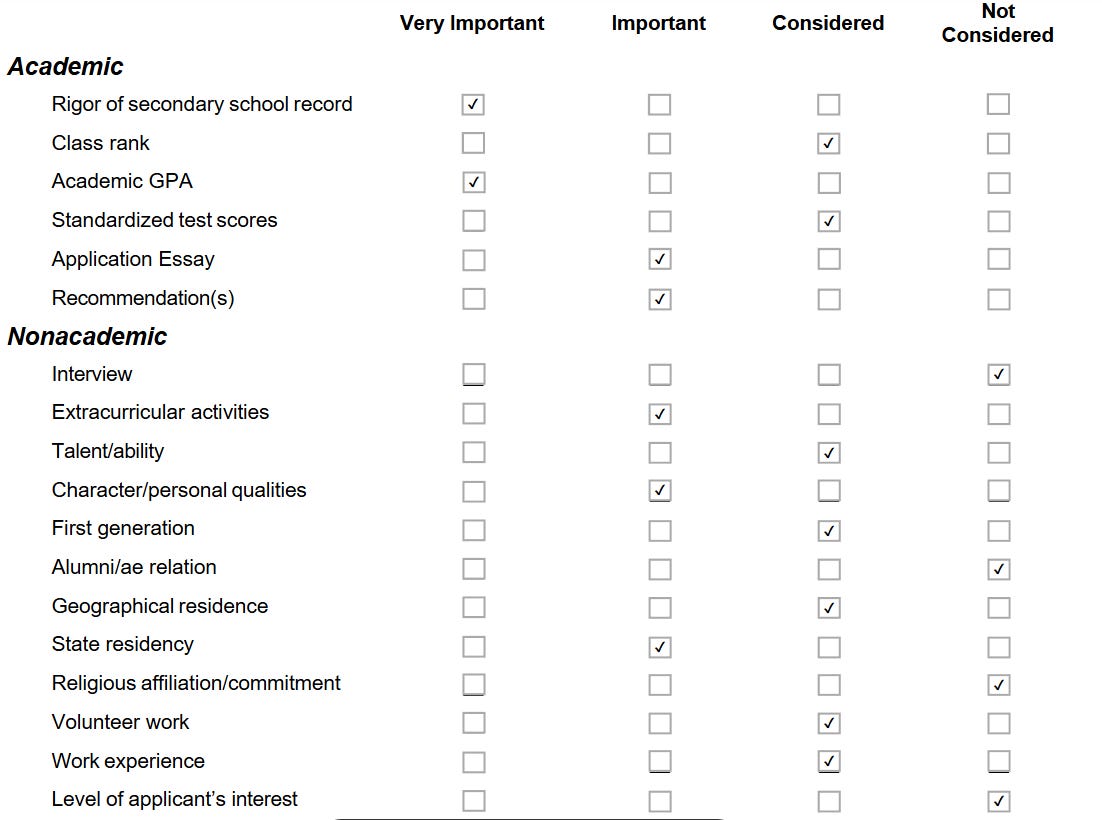
How important are standardized tests relative to grades, rigor, and activities?
This data tells a story, if you know how to read it.
See a real example below…

A Simple Rule of Thumb
Here’s a practical framework:
✅ If your score falls in or near the middle 50%
Submitting is often the smart move.
At that point, your time and energy are usually better spent on:
-
Strengthening academic performance
-
Deepening a research project or passion initiative
-
Securing meaningful work, internships, or leadership
-
Writing thoughtful, authentic essays
Four months of intense test prep for a marginal score bump often adds less value than students expect.
⚠️ If your score is meaningfully below range, but you have time
Retesting can make sense if:
-
There were real factors outside your control (illness, testing conditions, timing)
-
You’ve identified clear areas for improvement
-
You can prep intentionally, not reactively
Retesting just to “see what happens” is rarely worth the stress.
Why Colleges Still Care About Tests (Even Now)
Despite the test-optional narrative, standardized tests still serve an important purpose:
They give colleges a common academic benchmark.
If a high school has:
-
Grade inflation
-
Grade deflation
-
Inconsistent rigor
SAT/ACT scores can help contextualize your transcript rather than replace it.
And here’s the trend families often miss:
👉 More schools are quietly moving back toward requiring scores.
Understanding where your target colleges are headed, not just where they were last year matters.
The Real Question You Should Be Asking
Instead of asking:
“Is my score good enough?”
Ask:
“How does my score function within the context of my application?”
That answer depends on:
-
Your school profile
-
Your GPA trend and rigor
-
Your major
-
Your college list
-
How much testing actually matters at each institution
This is where blanket advice breaks down.
Where a Counselor Makes the Difference
This decision isn’t about guessing or copying what others are doing. It’s about decoding the data and applying it to you.
A counselor can help:
-
Analyze Common Data Sets across multiple years
-
Spot trends schools don’t advertise
-
Decide where submitting helps, where it’s neutral, and where it hurts
-
Build a balanced strategy so testing doesn’t overshadow stronger parts of your application
For many students, the biggest relief isn’t a higher score, it’s clarity.
Final Thought
There is no prize for suffering through test prep unnecessarily.
And there’s no advantage in hiding information that actually helps you.
The goal isn’t perfection.
The goal is strategy.
If you’re unsure which path makes sense for your situation, that’s not a failure, that’s a signal to get informed guidance.
And once you do?
You can finally stop spiraling over a number and focus on what actually moves the needle.
